

Beyond The Qualification Line
Why Law Enforcement Should Embrace Competitive Shooting

Sgt. Colin Gallagher (ret.) is a Legal Consultant and Law Enforcement Trainer based in Wichita, Kansas. He is currently the Director of Law Enforcement and Military Operations for Laser Ammo USA, Inc., a manufacturer of laser-based firearms training products and solutions.
BLUF:
Organized shooting, such as formal competition programs, is valuable, and its benefits greatly outweigh any possible flaws, real or imagined.
There is no evidence that participation in competitive shooting has created problems, despite claims to the contrary, as explained here:
Only a small fraction of shooters ever reach a point of diminished return in skill development, even among active, card-carrying shooting competitors, as explained here:
Beyond The Qualification Line
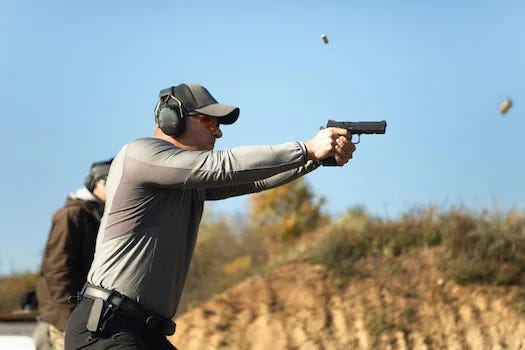
For decades, law enforcement firearms training has largely followed a predictable and standardized model. Officers qualify annually or semi-annually on static ranges, firing prescribed rounds at fixed distances under controlled conditions.
While these qualifications serve an administrative purpose, they always fall short of preparing officers for the realities of armed encounters. Modern policing demands more than baseline proficiency, it requires adaptability, speed, accuracy, and decision-making under pressure. To meet this demand, agencies must begin to expand their training models by integrating both traditional tactical instruction and non-traditional methods such as competitive shooting.
At its core, effective firearms training must recognize a fundamental truth: people learn differently. Some officers excel through repetition and structured drills, while others develop skills more effectively through dynamic, scenario-based environments. A one-size-fits-all approach to firearms training limits potential and leaves critical performance gaps unaddressed. By incorporating a broader spectrum of training methodologies, including competitive shooting, agencies can better equip officers with the skills necessary to perform under real-world conditions.
The modern armed encounter is rarely static, predictable, or forgiving. Officers may be required to engage threats in low light, from unconventional positions, and almost always while moving, or under extreme physiological stress. These situations demand more than marksmanship; they require the ability to process information, make rapid decisions, and execute precise actions under pressure. Traditional range training, although required, often lacks the complexity and urgency of these real-world scenarios. This is where practical and competitive shooting disciplines can play a critical role.
Competitive shooting introduces elements that are difficult to replicate in standard law enforcement training environments. Timers, movement, target transitions, and problem-solving under pressure all contribute to developing a higher level of performance. Officers participating in competitive environments are forced to think and act quickly, balancing speed with accuracy in a way that closely mirrors the demands of real-world encounters. The result is not just faster shooters, but more efficient and confident ones.
Despite these benefits, competitive shooting remains a controversial topic within some law enforcement circles. Critics often argue that it creates bad habits, prioritizes speed over safety, and does not reflect the realities of duty use. These concerns are not without merit, but they are often based on misunderstandings or incomplete application of the discipline.
One of the most common criticisms is that competition shooting creates “training scars,” such as exaggerated movements, unrealistic reloads, or a focus on speed at the expense of tactical awareness. However, this critique fails to distinguish between improper application and structured integration. When competitive shooting is approached as a supplement, not a replacement for tactical training, it becomes a powerful tool rather than a liability. The responsibility lies with instructors and agencies to contextualize these skills appropriately, ensuring officers understand when and how to apply them in a law enforcement setting.
Another frequent argument is that competition shooting is not realistic for duty use. While it is true that no competitive environment can fully replicate the complexity of a lethal force encounter, the same can be said of traditional range training. The value of competition lies not in its realism, but in the performance skills it develops. Drawing efficiently, acquiring sights quickly, transitioning between targets, and managing recoil under time constraints are all transferable skills. These are not “competition-only” abilities—they are fundamental components of effective shooting.
Perhaps the most emotionally charged criticism is the idea that competition shooting “gamifies” lethal force. This concern reflects a deeper issue within the profession: the need to clearly separate mindset from mechanics. Competitive shooting is about maximizing performance under stress and pressure. When properly framed, it reinforces discipline, control, and accountability.
The reality is that performance under stress is a perishable skill. Officers who only engage in firearms training during periodic qualifications are simply not going to maintain peak proficiency. Competitive shooting offers a structured and accessible way to bridge that gap. It provides regular opportunities for officers to test their skills, identify weaknesses, and improve in a measurable way. The immediate feedback provided by timers and scoring systems creates a level of accountability that is often missing from traditional training environments.
From a physiological standpoint, competition also introduces a level of stress that, while not identical to a critical incident, is still very valuable. The pressure of performing in front of peers, being timed, and evaluated creates measurable increases in heart rate and cognitive load. Learning to manage these stress responses in a controlled environment can help officers develop composure and focus when it matters most.
For patrol officers, the benefits are straightforward: improved confidence, faster reaction times, and greater accuracy under pressure. For firearms instructors and range staff, competition provides a wealth of drills, techniques, and performance metrics that can be adapted for agency use. For command staff, it represents a cost-effective way to enhance training outcomes without significantly increasing resource demands.
Agencies should consider how they can incorporate or encourage competitive elements into their training programs. This begins with a clear understanding that competition is a tool not a doctrine. It should complement sound tactical training rooted in policy, law, and real-world application.
A practical approach to integration starts with incorporating competition-based drills into existing training. Timed courses of fire, movement-based exercises, and target transition drills can all be introduced without overhauling current programs. These additions challenge officers to perform at a higher level while maintaining the tactical context required for duty use.
Policy considerations are also important. Agencies should establish clear guidelines that reinforce safety, accountability, and adherence to use-of-force standards. Officers must understand that while certain techniques may be effective in a competitive setting, they must always default to tactics that align with their training and departmental policies.
Encouraging participation in local and regional matches is a valuable measure. Many competitive shooting events are open to law enforcement and provide a supportive environment for skill development. These events allow officers to engage in additional training on their own time while representing their agencies in a positive and professional manner. Exposure to a broader shooting community can also foster innovation and the exchange of ideas, benefiting both individual officers and their departments.
Importantly, leadership plays a critical role in shaping attitudes toward this type of training. When supervisors and command staff recognize and support the value of diverse training methods, it creates a culture that prioritizes continuous improvement.
The goal is not to turn police officers into competitive shooters, it is to make them more capable, confident, and effective in their roles by exposing them to additional challenges in a variety of settings and environment. When combined with sound tactical training, scenario-based exercises, and strong policy foundations, it becomes part of a comprehensive approach to firearms proficiency.
Ultimately, the profession must ask itself a critical question: Is current training preparing officers for the realities they may face? If the answer is anything less than a confident “yes,” then adaptation is necessary. The evolving nature of threats, public expectations, technology and accountability demands a higher standard of performance. Standing still is not an option.
Firearms training should not be limited to meeting minimum standards; it should strive for excellence. By embracing a balanced approach that includes practical, tactical, and competitive elements, law enforcement agencies can better prepare their officers for the complexities of modern policing. The result is not only improved performance on the range, but increased survivability, better decision-making, and greater confidence in the field.
Practical Takeaways
Expand firearms training beyond static qualification courses
Integrate timed, movement-based, and decision-making drills
Use competition principles to enhance speed and accuracy under pressure
Establish clear policy guidance to align training with duty use
Encourage officers to participate in reputable local and regional matches
Foster a culture of continuous improvement and performance accountability
In the end, the debate over competition shooting is not about choosing between tradition and innovation, it is about recognizing that both have value. When applied correctly, competitive shooting does not detract from law enforcement training; it strengthens it. And in a profession where performance can mean the difference between life and death, that is a distinction worth embracing.
Original article link:
https://calibrepress.com/2026/04/beyond-the-qualification-line-why-law-enforcement-should-embrace-practical-tactical-and-competitive-shooting/