


A recent thread on Hoglegs, Hipshots and Jalapenos took me back to the late 1950s and early 1960s. I was just a kid devouring the writings by and about Skeeter Skelton and Jeff Cooper. Readers commented that he enjoys researching the origins of the art of gunfighting, so I thought he and others might be interested in an excerpt from my The M1911 Complete Owners Guide. See also The M1911 Complete Assembly Guide
One of the proudest moments of my life was the day that Janelle Cooper declared the following as “The best succinct history of my husband that I have ever read.” Thank you, Janelle, and thank you for being the life partner of Jeff, making possible his accomplishments and contributions.
- Walt Kuleck
Videos about the history of early shooting competitions:
The Major
by Walter Julius Kuleck
In 1945 an icy slip and fall around Thanksgiving left a junior Major of Marines with the head of his right radius shattered into six pieces. After surgery and a difficult, painful recovery, to regain full use of his right arm he would have to perform a long course of physical therapy. Christmas of 1945 came and went; first, the Major tried tennis, but the overhead serve was just too painful. By some quirk of fate, his family’s quarters at Quantico overlooked the FBI shooting range. The sound of small arms fire drew him like a moth to the light. Perhaps the draw stroke would loosen the adhesions that were limiting his function and causing his pain. Thus the Major’s physical rehabilitation — and epiphany — began.
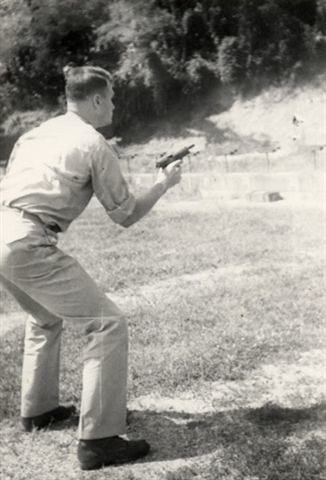
The Major gained access to the FBI range on a guest basis; at that time, the FBI was a tenant of the Marine Corps at Quantico (today, of course, the FBI has its own facilities there). He shot the FBI courses of fire, choosing to use his military pistol. After all, he had spent his entire military career with the M1911 and was comfortable with it. However, his use of the M1911 created a problem for the FBI; on every course of fire, his talent and his pistol smoked the FBI shooters. “Unfair!” was the cry; “You don’t have to reload after six!” So, the Major downloaded his magazines; even with mag changes, he prevailed. “But we have to reload from a drop pouch!” Unfazed, the Major shot six, reloaded his magazine with loose rounds, and still remained unbeatable. The Major began to learn from this experience; the FBI took about forty years longer to catch up.
The Major found a shooting partner, another Marine, Captain Howland “Howie” Taft, assigned to the Marine Corps Equipment Board. Together they shot, and thought, and shot some more. To the Major and the Captain, it began to become clear that the pistol was to be mastered as a practical tool through practical training, not through one-armed, off-hand-in-pocket bullseye shooting. During all this time, the Major’s role in the Marine Corps was largely as a teacher; in retrospect, it is clear his destiny was to be a teacher all along. The world would be a better place for it.
The tangible result of the Major’s and Captain’s collaboration was the very first training course and manual for the use of the pistol in a realistic manner: the US Marine Corps Advanced Practical Pistol Course. Though the Major was not aware of it at the time, the die had been cast; his life, and the lives of literally millions of men and women would be changed forever.
During this post-WWII period, the Major found himself much like the M1911 pistol; both were warriors in excess of requirements. The Marine Corps didn’t require nearly as many Majors as it had at the cessation of hostilities. During the war, the Major had had the necessity to defend himself against Japanese soldiers on two occasions, during one of which he prevailed using a Colt Peacemaker, the other, with an M1911. However, his wartime experience had been primarily aboard the USS Pennsylvania (BB-38). Since he had not had the opportunity to lead Marines in ground combat, he found himself at a competitive disadvantage with those Majors who had won distinction as infantrymen. Thus, the Major decided to leave the service in 1948 when his term of service ended. But, when the North Koreans swept over the 38th parallel, he answered the call of the colors, this time serving in the field with the Central Intelligence Agency.
The time the Major spent with the CIA will forever remain shrouded in mystery, as he took his commitment to secrecy to the grave. We do know that at one point during a period in Thailand, he and his driver were set upon by a hitman with a Sten gun whilst traveling down a country road. The Major returned fire from the vehicle; when the smoke cleared and the pair ventured forth from the ditch in which they had taken refuge, the first thing visible was the sole of their assailant’s shoe. We should not be surprised that the Major’s weapon was his M1911. This third lethal encounter confirmed for him that the M1911 and its .45 caliber cartridge were worthy of his trust and confidence.
With the end of the Korean War and his service with the CIA, the Major once again found himself redundant to the needs of the Corps. Now a Lieutenant Colonel, he was one of the hundreds of light colonels in the Marines, which had only 24 Battalion Commander billets for them. Once again, he left the service, this time not to return.
That Major, now a retired Lieutenant Colonel, was of course John Dean “Jeff” Cooper.
Renaissance
Once again in civilian life, Jeff first became involved in sports cars and auto racing, first with an MG and then with a series of Porsches. During this period, he founded the Porsche Owner’s Club of Southern California. Jeff joined a group planning a venture to build an auto racing venue. When the project was abandoned by its financial backer and fell through, one of his associates in the project felt bad enough for Jeff that he sought to compensate him for his time and trouble by introducing him to Robert E. “Bob” Petersen, founder of Petersen Publications (Motor Trend, Hot Rod, Trend Books, et.al.). It is with Petersen Publishing that Jeff began his long writing career.
Jeff’s first book was for Petersen’s Trend imprint: Sports Car Annual for 1957. In addition to the customary listings of sports cars on the market, Jeff included a chapter on “The racing line.” Jeff had learned by doing, by following and emulating racers such as Dr. Dick Thompson (the racing dentist). He asked several prominent race drivers to vet this chapter; the result was the first exposition of the principles and techniques of cornering ever published. This was another example of Jeff’s ability to capture the principles and execution of complex actions, an ability that was to serve him well in the years to come. After this first effort, Petersen Publishing was to be an important outlet for Jeff’s concepts and ideas and a much-needed albeit modest source of income.
At about this time the Cooper family moved to the Big Bear Lake area of California, in the San Bernardino Mountains a hundred miles east of Los Angeles. Big Bear was a nascent resort area that was to be the Cooper home for nineteen years. After the move, Jeff had the opportunity to invest in a new ski resort: Snow Summit. However, ski resorts by their very nature are seasonal; thus, to bring visitors to the area in the “offseason,” summer activities would be required.
The Big Bear area already had a local “Miners’ Days” festival in August, an event still held to this day. Jeff came up with the idea for a “fast draw” competition to be held at Snow Summit as a way to publicize the resort and supplement its income. This event, the First Annual Leatherslap, drew some two hundred competitors. It was so successful that the locals decided to organize a monthly match. During Miners’ Days, a certain amount of period “dress-up” was to be seen, though perhaps not at the level of today’s Cowboy Action Shooting events. Jeff took up the theme by researching period gunfights and gunfighters such as the OK Corral, taking the Leatherslap away from a pure fast draw competition to a practical handgun contest.
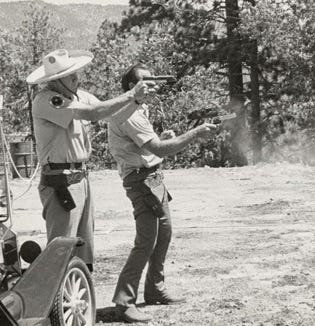
Jeff’s interest in and love of history fueled his research into scenarios that reflected real life. While the FBI had had its “Hogan’s Alley,” a mock town with movie-lot flats and pop-up bad guy targets, Jeff’s evolution of the Leatherslap into the Bear Valley Gunslingers and the later Southwest Combat Pistol League was unprecedented. Jeff had created not only the concept of practical pistol competition with varied and realistic courses of fire, but also a laboratory to research the equipment, tactics, and techniques that would prevail not only in competition but also in the real world. That First Annual Leatherslap in 1957 was to mark the beginning of a revolution.
Incubation
While the Big Bear shooters were developing the “New Technique of the Pistol,” Jeff Cooper was analyzing, thinking, and writing about their experiences. One day a fellow named Jack Weaver came to shoot and lost badly. In the spirit of inquiry that infused Big Bear competition, Jack went away and came back with a new shooting stance. Jack’s two-handed, isometric hold vanquished the established competitors, Jeff included. Jeff looked closely at Jack Weaver’s style, thought about it, tried it, and found it good. Very, very good. Jeff began to write about Jack’s technique, dubbing it the “Weaver Stance.” The Weaver Stance was but one example of the effective approaches forged in the fires of the practical competition that Jeff had innovated.
Jeff began to write about handguns and handgunning for Petersen, reporting in specialty books and Guns and Ammo articles about the new approaches being perfected in practical competition. These writings captured the attention of people around the world, some of whom had the need and the means to request a personal consultation with Jeff. Jeff went to South Africa, and the UK, and Latin America, instructing in both the “Modern Technique” and Jeff’s emerging “Principles of Personal Defense.” Clients quickly realized the value of the Modern Technique, and Jeff’s reputation and success as a consulting trainer grew apace.
It was during this time that the status of the Model of 1911 as the premier self-defense sidearm became clear. In practical competition, shooters were free to use any handgun they chose. What they, and Jeff, found was that if you weren’t shooting a Model of 1911, you weren’t winning. The purpose of practical competition was to find the most effective tools and techniques for the personal defense task. The Model of 1911 emerged as the most effective tool, and the Weaver stance, the most effective technique. The M1911 was not without faults, however; the sights, for example, were too small for quick acquisition. The trigger of most standard M1911s was not as crisp and free of creep as needed to foster effective trigger control. A specialty in gunsmithing began to emerge, “pistolsmithing,” as techniques for upgrading stock pistols to meet the needs of practical shooters in practical competition became clearer.
Jeff and his family realized that there was a need for a dedicated facility with a dedicated staff to train the Modern Technique and teach the Principles of Personal Defense. Once Arizona was identified as an appropriate location based on its environment, both political and climatic, the Coopers bought a parcel of land outside Paulden, Arizona, and built both living quarters—soon to become known as “The Sconce”—and what evolved into a state-of-the-art firearms training facility that became renowned worldwide as “Gunsite.”
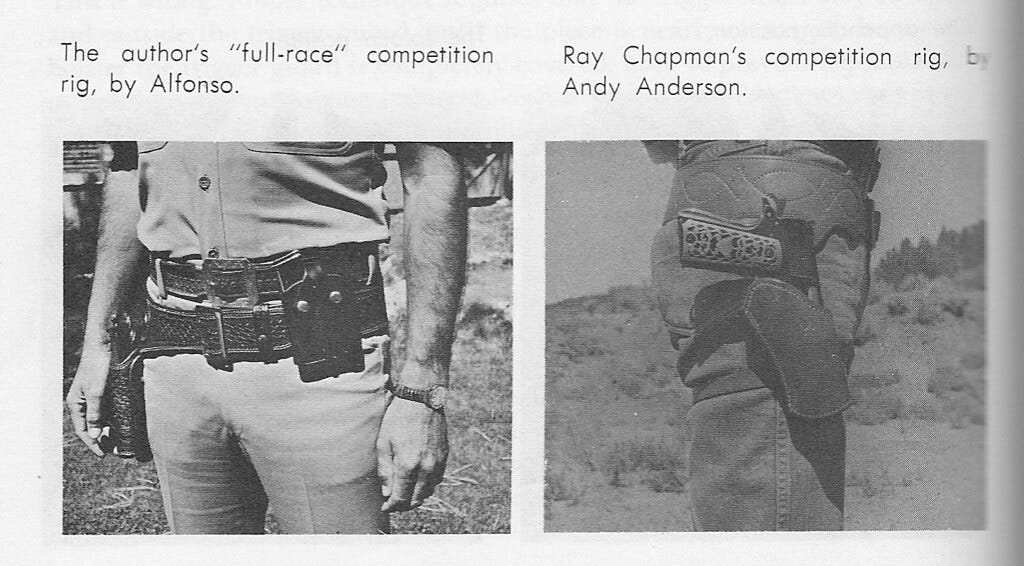
During this period—the mid-1970s—as American Pistol Institute and then Gunsite began to take shape, the International Practical Shooting Confederation was founded. Today, with IPSC, the International Defensive Pistol Association (IDPA), the Single-Stack Society, The Glock Sport Shooting Association (GSSA), and others, it may be hard to recognize that before Jeff Cooper, there was no practical handgun competition, no “practical” handguns as we understand them now, and no effective defensive pistol techniques. For practical purposes, before Cooper, there were no pistolsmiths, no parts manufacturers (“Want an extended safety? Fire up your welder!”), no training schools, no trainers.
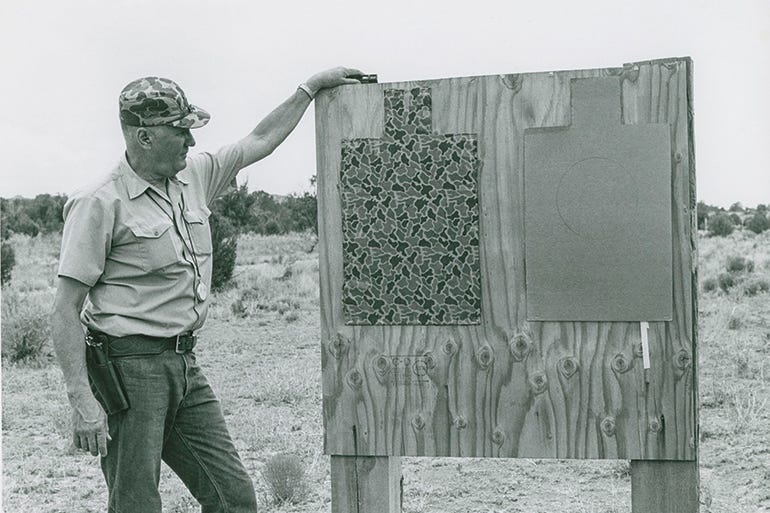
It may be said that Jeff Cooper changed the world of shooting more profoundly than anyone since John Browning himself. Thanks to Cooper, there is now a vibrant Model of 1911 manufacturing industry, with scores of companies that have come and gone, and scores more that remain. Thanks to Cooper, there are robust upgrade and aftermarket parts and holster and light and laser industries, filling page upon page of Brownells’ and Midway USA’s catalogs. Thanks to Cooper there are custom pistolsmiths and “production custom” manufacturers. Thanks to Cooper, there are trainers and schools from Massad Ayoob’s Lethal Force Institute to Clint Smith’s Thunder Ranch. An entire generation of trainers has come out of Gunsite, as staff, students, or both. And yes, the Model of 1911 has spawned an array of vibrant competitors, from CZ to Glock to Heckler & Koch to SIG-Sauer and more, who would not have had a defensive sidearm market to enter had it not been for Cooper.
And finally, it can be argued that the forty or more states that have enacted “must-issue” concealed handgun permits and licenses enacted those statutes because of the demand from competent citizens with effective equipment to use those skills and abilities to defend their lives and families. But, another factor may have been even more compelling in the self-defense context: the defensive mindset.
Perhaps the most significant contribution by Jeff Cooper to his fellow citizens was articulated in a slim volume: “Principles of Personal Defense.” Cooper was much, much more than a shooter, or the chronicler of shooters, as important as those contributions were. Jeff Cooper was a historian, a philosopher, a culture warrior before we came to know what a “culture warrior” might be. Cooper taught us not merely how to shoot, but articulated and inculcated the responsibility each one of us has for self-reliance, for leading a life of honor, integrity, and courage. The purpose of Personal Defense is not merely to shoot more competently than an aggressor, but more fundamentally to exert one’s moral imperative to resist and conquer evil. For many, Cooper’s steadfastness was his most inspirational quality. He was the embodiment of “Duty, Honor, Country.”
In the years since the establishment of Gunsite and the founding of IPSC, the world of the Model of 1911 has expanded to a point that could not have been foreseen by John Browning. The M1911 has become both an icon and a standard against which other pistol designs must be measured. To many, the Model of 1911 has yet to be surpassed as the ne plus ultra of defensive sidearms.
I needed to save this article for thos evening. Its a X-ring "crossbar"!
As a young lad, many years ago, I avidly read Chairman Jeff's articles in G&A. They were awesome. His intellegent, erudite exposition on all things shooting shaped my own study and learning the skills needed to accurately shoot a handgun. Once I wrapped my hands around a 1911 (A1), that was addicting as nicotine. I am convinced that the 1911 platform serves any need a handgun may be put to. As my late Father was left handed, the value of adding an ambidextrous thumb safety became quickly apparent; all of my 1911's are so equipped. I also learned to shoot ambidextrously.
When the pernicious politicritters of NYS enacted the (UN)SAFE Act, the original 7 round magazine capacity for semi-automatic pistols left the 1911 in 45 ACP as a viable option in carry pieces. The USMC adage; Improvise, Adapt and Overcome came to mind. What enraged me was that I had acquired a genuine late model, Type IV Browning Hi-Power; finding it to be an excellent package to wrap around the 9mm Parabellum. And, about that time, there was a surfiet of used Malaysian surplus Hi-Power magazines in good condition available for stupid cheap.
Caliber choices of the modern 1911 are adequate for any and all uses. In my biased opinion, the original clambering, 45 ACP is less flexible than others the platform is available in. The 10mm, 38 Super and 9mm offer flatter trajectories; SAAMI/ANSI specifications allow for higher pressure leading to higher velocity.
My experience is with the 10mm; it serves just about any purpose I need a centerfire handgun for. The 45 ACP takes 2nd place; certainly appropriate for staying alive in bad situations, delivering excellent precision for making holes in targets in properly fitted handguns and has the advantage of tolerating downloading better than the 10mm. Its also less expensive to shoot as cases are much more readily available. For pure shooting delight, a 1911 in 22 lr. is hard to replicate (although a S&W M-17 comes darn close).
6 metallic cartridge versions, and 2 CO2 pistol versions later, I believe I may have just enough to head in to my elderly years. However if the right 9mm 1911 comes available (like a Springfield Armory RO Tactical Elite) I may have to increase the number of cartridge 1911's in the vault. The 9 is quite cost effective as a centerline handgun round and fun to shoot in quantity.
The last shoot of the year is coming up, considering I haven't uncorked a 45 all year........ The Kimber TCT may get dirty....
I don’t even own a 1911, but have 5 2011’s. It’s one I just never got around to buying. Now I can’t buy anything ( thanks Trudeau)