

Preoccupation with Inconsequential Increments (Myth)
Preoccupation with Inconsequential Increments is bad, Ignorance of Nonexistent Increments is worse.

Lt. Col. Jeff Cooper coined the phrase “Preoccupation with Inconsequential Increments” (PII) to describe the human tendency to obsess over tiny, measurable differences in equipment or performance that have no meaningful impact on real-world results. He defined an “inconsequential increment” as a difference that has no significant relationship to the purpose of the exercise.
“Years ago we coined the appellation, ‘Preoccupation with Inconsequential Increments,’ or PII. This peculiarity lies in attributing importance to measurable deviations so small as to be meaningless. You see it in the people who shoot test groups in rifles, awarding a prize to a group which is only thousandths of an inch smaller than those unrewarded. One sees it in speed records awarded in one-thousandths of one mile-per-hour. One sees it in basketball scores which, nearing the century mark, are separated by less than three points. In all such cases Score A is ‘better’ than Score B, but who cares?
“An increment may be termed inconsequential when it has no significant relationship to the purpose of the exercise. Of course, if the purpose of the exercise is in itself inconsequential, some may not think this to be foolish. A very distinguished general at Quantico once caused the sign to be placed over the exit door of every office asking, in brilliant scarlet and gold, ‘What are you trying to do?’ There was a man who knew more about human nature than most.”
While Cooper was certainly correct, this ignores a much bigger problem: What about Ignorance of Nonexistent Increments?
Some people in the tactical community obsess over the “problem” of other shooters, particularly those in the competition realm, being overly obsessed with performance. You’ve heard the excuses:
“There aren’t score zones or stopwatches in real life.”
“Don’t play timer games or circus tricks.”
“Hoping more people wake up from the distraction that timer drills and qual courses often become.”
Andy Stanford recently released his new book, Gunfighter U, Mastering the American Martial Art, where he opines:
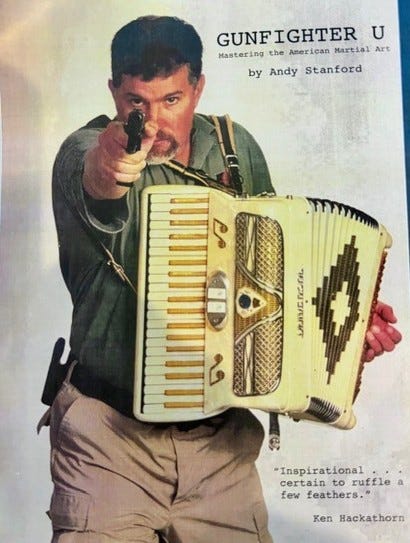
“To get a Grandmaster card or win a major match requires many esoteric skills that have nothing to do with gunfighting.”
Mr. Stanford summed up his advice for new martial-minded gun owners starting out on how to avoid PII:
“Shoot at least twelve matches total, not more than one a week, no fewer than one a month. If you wish, shoot until you reach a B Classification in USPSA, or Expert in IDPA. Then throttle back to one or two matches a year at most. At this point, spend your spare time learning tactical medicine or applied combatives. Or conversing with your significant other. Or playing with your kids.”
Many in the tactical community express concerns about preoccupation with range results, warning against Preoccupation with Inconsequential Increments as if it were some existential threat.
A preoccupation with PII is itself a preoccupation with inconsequential increments. Far worse than PII is Ignorance of Nonexistant Increments.
I’m not worried about top competition shooters; there aren’t enough of them to worry about, which should be a concern for different reasons. I’m much more concerned with the many MILLIONS of military, law enforcement, and individual gun owners that never reach useful levels of skill. They’re not nearly as good with firearms as they should be, and are usually unaware of it: they have Ignorance of Nonexistant Increments concerning their lack of skill.
The U.S. military has about 2.1 million uniformed personnel in all branches, active and reserve. Add to this about 750,000 sworn law enforcement; that’s about 2,850,000 armed uniformed personnel in the public sector. Over 60 million Americans state they own a firearm for protection, something that about 70% of Americans state is at least one reason why they own at least one gun.
Various competitive action or practical shooting disciplines are relevant here and draw the most attention. The most popular of these competition shooting formats with national-level organizations tops out with a few ten thousand members. USPSA lists about 37,000 members, IDPA 25,000, PCSL 4,500; any other groups are smaller. If we add these together, ignore the overlap among people who are members of more than one group, include participants who aren’t card-carrying members, and then generously round up, we might have about 100,000 total.
Tactical PII
Even if every competitor was also military or sworn law enforcement (they’re obviously not), that means 96.5% are NOT participating in any capacity or at any level. Taking the better assessment that 60 million Americans owning a defensive firearm also includes military and police, that’s a 0.165% particiation rate - 99.835% of military, police, and civilian gun owners that already have a firearm suitable to participate in these events, don’t.
This already indicates that 624 out of 625 gun owners have never participated in a match.
Of those that have, most of the actual participants are far from a “Preoccupation with Inconsequential Increments.” According to data published by the International Defensive Pistol Association, their most popular Stock Service Pistol division has less than 12% of their membership Classified as Expert, and only 4% earned Master.
Contrast this to formal testing of civilian and military law enforcement showing most of them are incapable of being competitive in the LOWEST skill bracket. Article and videos with citations:
Link to article with citations:

In USPSA, about 65% of current classified shooters are D or C class, and about 25% are B class.
Using Stanford’s stratification, at least two-thirds of current participants would be well served to push for an INCREASE in scores; less than a quarter (15-25%) are at a skill level he recommends as beneficial but not excessive.
That means only 5-10% of current participants have pushed into a level Stanford considers higher than useful, allegedly due to their Preoccupation with Inconsequential Increments. That’s 5-10% of 0.165%.
Ten percent of 100,000 participants is 10,000; about 0.016% of the 60 million total, or less than 1 in 6,000.
For every 6,000 people with defensive firearms, one of them MIGHT be pursuing shooting skills beyond a reasonable level. The other 5,999 would be well served to shoot matches and work to improve their scores.
People who are expressing concern over that one person in 6,000 clearly have a Preoccupation with Inconsequential Increments.
Additional info from Claude Werner, Tactical Professor:
"I calculated 1 in 1,000 gunowners in the Atlanta Metro area can NOT can draw from a holster; hardly any indoor range in the Metro area allows shooters to draw from a holster or do any moving.
"What that means is that the other 999 shooters have only two venues where they can draw from a holster; at a match or at a training event. The match I go to costs $20 to enter; the resource requirements for a training event obviously exceed that by a large margin."
"Another aspect of competition that I think is useful could be described as legally and morally defensible performance standards. In a competition, the bare minimum standard is to hit the silhouette with every shot. Experienced shooters will rarely miss the entire silhouette. Even Novice competitors will hit the entire silhouette somewhere in the 80-90% range because they know that misses dramatically hurt their score. This far exceeds the most common Qualification standard of 70% and the general ~50% average seen at indoor ranges. We all agree that the only safe place for bullets to land is in the body of a criminal attacker so I think getting that hit average up is a good thing."
https://thetacticalprofessor.net/competition-alternate-pov/
I'm going to sound like a heretic. Preoccupation with draw times is another area where there are inconsequential increments.
In RO'ing our local club tactical matches; I've found the average draw to 1st shot time, using a competition holster, is about 1.75 - 2.0 seconds. Not the 1 second time most trainers call adequate. These people rarely practice draw from concealment. I do.