

Why Every High School Student Is Learning to Shoot a Gun - in Latvia
How Latvia now follows an American idea that most Americans have forgotten.

The U.S. government has been offering firearms to civilians and organizing marksmanship events with the intent of helping all Americans to become well-regulated in the use of arms. Details of this program, article and video:
Link: Marksmanship training for American Civilians
Here’s how Latvia has implemented a similar idea
Sindija Brakovska is 18 years old and currently studies at the Riga Technical School of Tourism and Creative Industry, a vocational school centered on hospitality, tourism, and fashion. However, today’s class has a different focus.
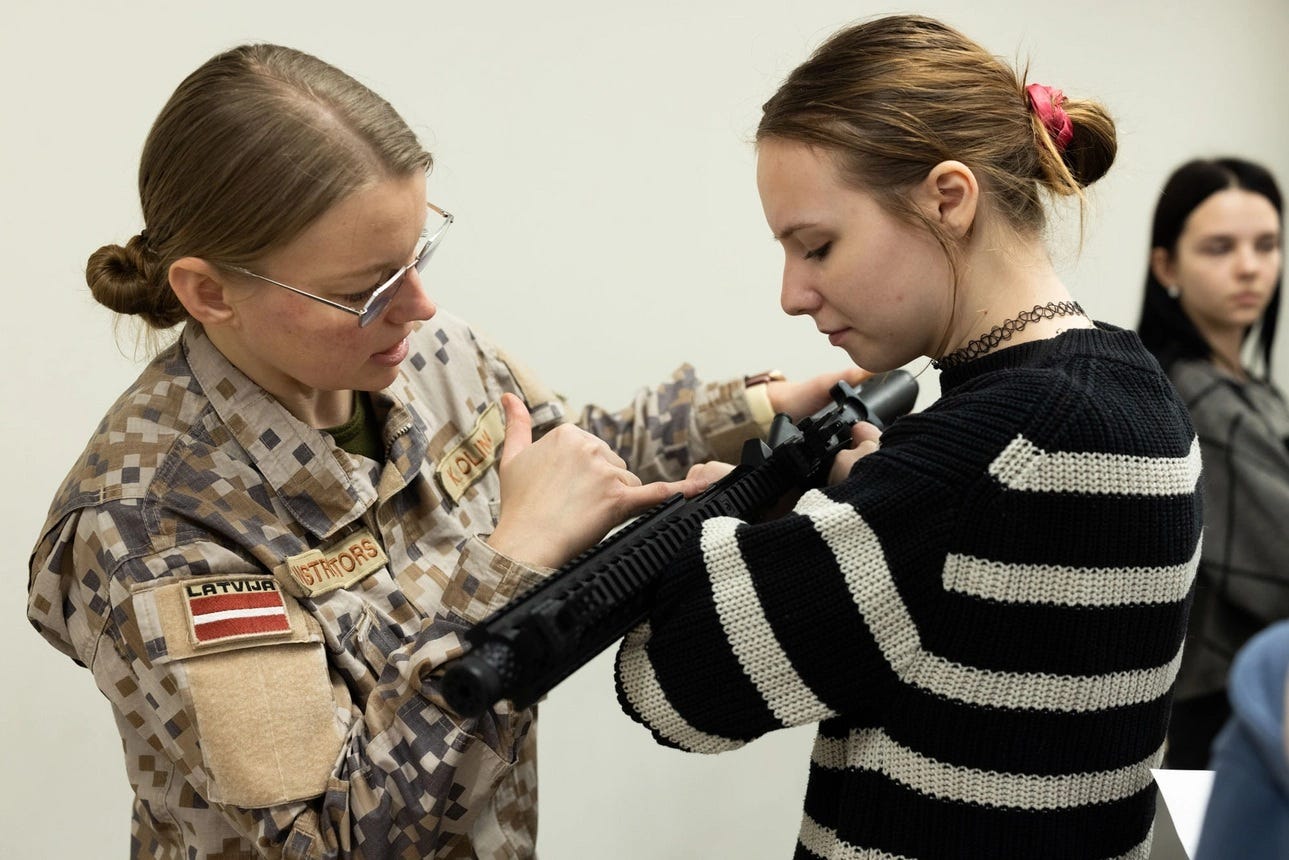
The room could be almost anywhere in Europe — if not for the rifles on the desks. They are clunky, black and weigh over 6 pounds. Made by the American manufacturer Crosman, model SBR, the air rifles resemble the military-issue U.S. M4.
“I’m a little nervous,” Brakovska says before she picks up a weapon for the first time. What does she make of her national defense class? “I think it makes sense.”
In many European countries, rifles in a classroom would be a scandal. In my home country, Germany, for example, the influential Education and Science Workers’ Union firmly opposes any form of military outreach in schools, viewing even visits by so-called “youth officers” with skepticism, as they are seen as a subtle form of recruitment.
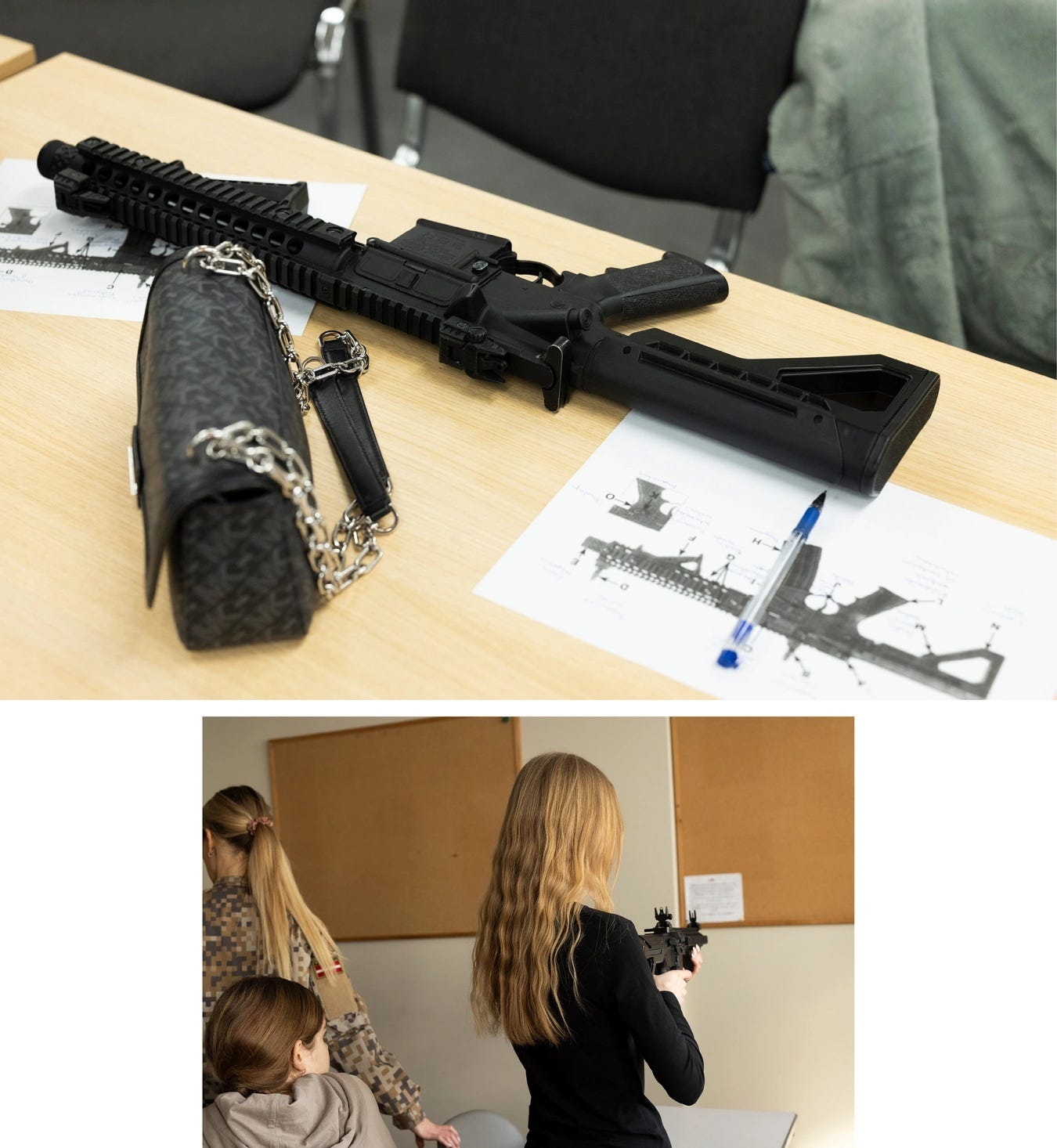
In Latvia, by contrast, there is no such resistance, and weapons training has become part of the lesson plan, even for budding hairstylists and dance teachers.
The country sits on the eastern shore of the Baltic Sea, with Russia to the east and Belarus to the southeast. Together with its neighbors Estonia and Lithuania, Latvia spent decades inside the Soviet Union. This is NATO’s northeastern frontier, and allied troops are stationed across the region; it now hosts a Canada-led multinational brigade, and American forces operate in the country as part of the alliance’s deterrence posture.
All three European countries have military conscription. In Latvia the service is compulsory for young men, but not across the board: if too few volunteers come forward, the remaining recruits are chosen by lottery. Currently, around 400 young men are drafted this way each year, while roughly 1,300 volunteer.
In addition, both Latvia and Estonia have introduced a compulsory “National Defense Education” for students in secondary school. The syllabus includes military history, marching and drilling, land navigation, first aid, crisis response and weapons handling. Students who want more can spend part of the summer in camp, in uniform.
Of the three counties, Latvia goes the farthest in mandating military training to high school students. In Estonia, the mandatory classroom course is 35 hours. In Latvia, it runs 112 hours over two years.
“The purpose is not to train soldiers, but to develop more responsible citizens,” Col. Valts Āboliņš tells me during a break in one of the school’s classrooms. The 53-year-old officer oversees the national program. “We want to remove the phobias many young people and their parents have when they encounter anything military.”
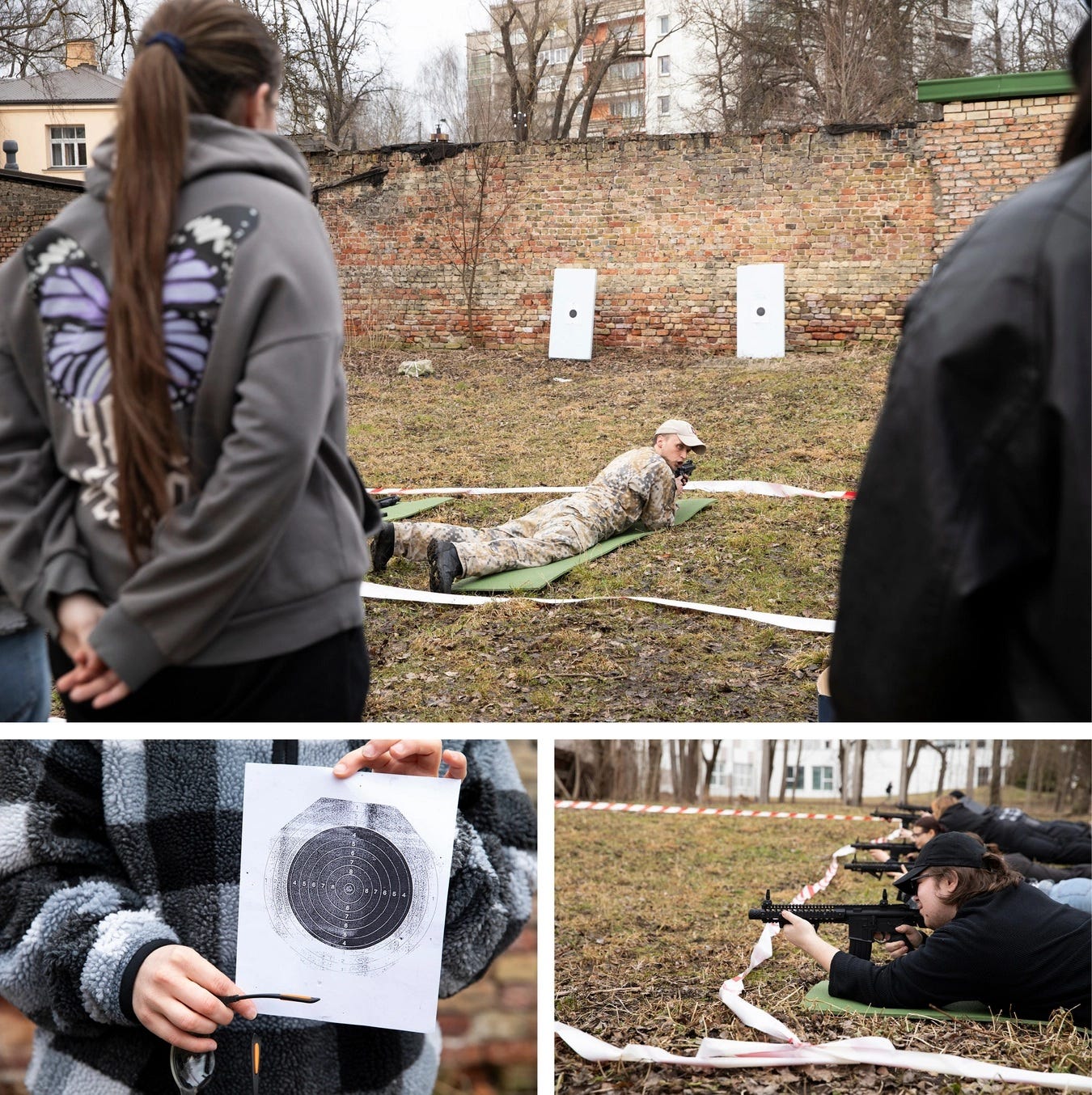
Nearby, students in their second year of the course are allowed to shoot loaded BB guns. For that, they simply lie down on the grass beside the school’s main entrance. An instructor marks the firing zone with red-and-white tape. The paper targets lean against a wall; sheets of Styrofoam serve as backstops. In the background, Riga’s Soviet-era apartment blocks rise into the sky.
The shooting range has an air of improvisation, but the rules are enforced with notable strictness. Weapons always lie in the same place, and every movement is preceded by a command. No one fires without an order.
There was debate in Latvia about the program, Āboliņš says. But it was “surprisingly calm.” The crucial thing, he argues, was that the government introduced it gradually. The first courses began in 2018 in 13 schools, all on a voluntary basis. More schools joined each year. By the time the course became mandatory on September 1, 2024, most were already taking part. Russia’s full-scale invasion of Ukraine did the rest.
How does a country in defense mode deal with young people who do not want to touch a weapon? “We don’t force anyone,” Skanis says. If someone is a convinced pacifist or says that his religion forbids it, the instructors ask for a presentation in the classroom instead. At least in peacetime.
“If war comes to Latvia, everyone needs to be ready,” Skanis says. “Some say they’ll fly away, but there won’t be any planes leaving anymore.”
That said, pacifism is much less prevalent in Latvia than elsewhere in the EU. Across the bloc, willingness to fight for one’s country tends to be low in Western Europe and markedly higher in the states that live in Russia’s shadow.
Full article:
https://www.politico.com/news/magazine/2026/03/28/latvia-russia-war-guns-students-00848017